
Why electrical safety must remain part of leadership conversations across the construction sector
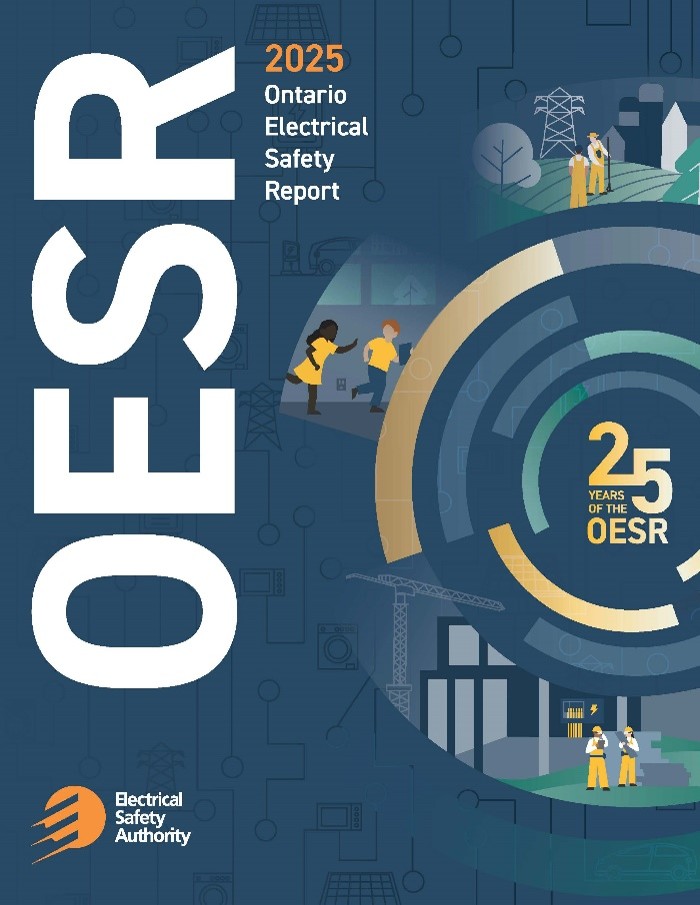
Preventing electrical incidents begins with understanding how and where they happen. For 25 years, the Ontario Electrical Safety Report (OESR) has provided that picture, giving safety leaders the evidence they need to make better decisions and focus prevention efforts where they will have the greatest impact.
It remains the only publication of its kind globally to provide a consistent annual picture of electrical fatalities, injuries and incidents.
Progress, with more work ahead
The 25th edition of the OESR coincides with an encouraging milestone: Ontario went 16 consecutive months without a reported electrical fatality between 2024 and 2025. In 2025, just two electrical fatalities were reported, the lowest annual total since 2012.
These results reflect the importance of sustained prevention efforts and collaboration. But fatalities alone do not tell the full story. Serious injuries and close calls continue to reveal risks that require attention, including on construction sites.
What the numbers mean for construction
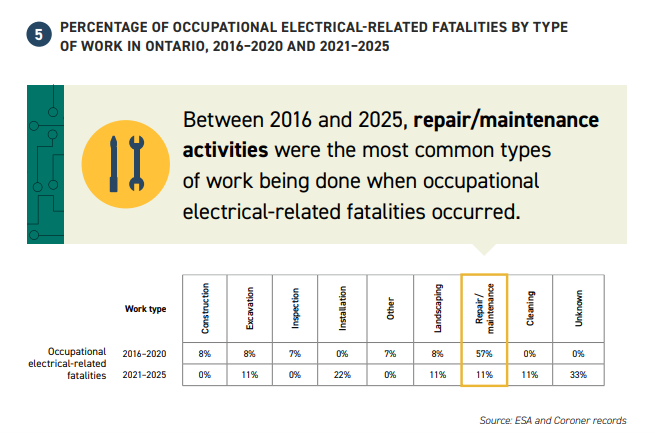
From construction workers and excavation teams to crane and boom truck operators, roofers, arborists and landscapers, many people in the trades regularly work near overheard powerlines, underground electrical infrastructure or energized equipment. While they may not think of electricity as part of their job, it can still be one of the most serious and potentially life changing hazards they encounter at work. That’s why it is so important to stay focused, be aware of your surroundings and avoid distractions while working.
Protecting workers requires leadership attention before work begins and whenever site conditions change. The latest OESR provides several reasons to keep that responsibility in focus:
- Progress has been made, but the trends are not all moving in the same direction. The rate of work-related electrical fatalities was 38 per cent lower in 2021-2025 than during the previous five years. Over those same periods, accepted Workplace Safety and Insurance Board (WSIB) claims involving electrical injuries increased from 245 to 305.
- Powerlines remain one of the most serious hazards facing workers. Powerline contacts caused 41 per cent of all work-related electrical fatalities over the past decade.
- Construction continues to record a significant number of injuries. Between 2016 and 2025, the sector had 188 accepted WSIB claims for electrical injuries that caused workers to miss time, more than any other sector listed in the report.
- The data points to a younger, predominantly male audience for prevention. People aged 20-39 accounted for 52 per cent of fatal electrical injuries over the past decade. Men represented 78 per cent of emergency department visits for electrical injuries, with men aged 25 to 30 recording the greatest number of visits.
Powerline lessons every site should reinforce
A fatal incident in Durham this past July is a sobering reminder of the risk. A worker was electrocuted when a boom lift contacted an overhead powerline. High-reach equipment like this is used on construction sites every day, making powerline awareness an essential part of training, planning and supervising the work.
Construction leaders can reinforce a few critical expectations on every site:
- Identify overhead powerlines before work begins and inform everyone on site, including placing warning signs.
- Locate all underground services. Arrange utility and private locates before excavation by contacting the Ontario Dig Authority.
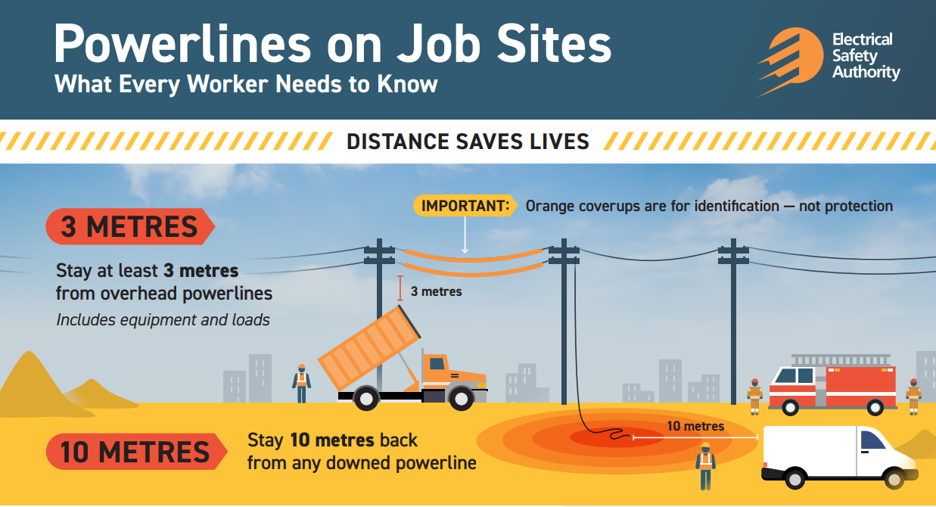
- Keep workers, tools, equipment and loads at least three metres from overhead powerlines. Electricity can arc without direct contact.
- Use a dedicated, competent signaller whenever equipment could come within three metres of a powerline.
- Remember that orange powerline covers only make the lines easier to see. They do not provide insulation or protection.
- If equipment contacts a powerline, call 911 and warn others to stay at least 10 metres away. Assume the line and equipment are energized until the local utility confirms it is safe.
Download Powerlines on Job Sites Infographic
Leadership and collaboration
One of the greatest benefits of good safety data is its ability to inform what happens in the field. Over 25 years, evidence from the OESR has helped shape public education, training, partnerships and changes to the Ontario Electrical Safety Code.
The report itself is built through collaboration with the Office of the Chief Coroner, the Ministry of Labour, Immigration, Training and Skills Development, the Office of the Fire Marshal, the Canadian Institute for Health Information and WSIB.
These findings are relevant to safety leaders throughout the electricity and energy industries, and to those in construction and related sectors where workers may encounter electrical hazards even when electricity is not the focus on the job.
Construction is central to Ontario’s economy and to meeting increasing electricity demand, and electrical safety must be considered as an inherent part of every job before crews arrive on site and throughout the construction life cycle through to completion. ESA works closely with safety leaders and workers to ensure our guidance reflects incident data in order to target the highest risks in the field. Awareness is important so that workers recognize hazards and know they can speak up, pause work or refuse work until the situation is made safe, such that injuries can be prevented and lives saved.
Resources for construction leaders
Explore ESA’s construction powerline resources, including a free 10-minute module, job site infographic, equipment-specific guides and free safety materials at ESAsafe.com/construction.
For teams looking to build their electrical safety knowledge, ESA Training Solutions* also offers award-winning safety and technical courses to help employees with the knowledge and skills needed to mitigate risk and foster a culture of safety in the workplace. We are proud to offer one of our newest courses, “Electrically Safe: Safety Awareness for Non-Electrical Trades,” which is designed for workers who do not perform electrical work but may work in environments where electrical hazards are present. It helps learners spot hazards, keep a safe distance and know what to do when they encounter unsafe work conditions.
*Training is a non-regulatory service offered by the ESA. Electrical safety and technical courses may be offered by other providers.